

Services
Industry
Year
Brief / Overview
Tender Skin is a Mexican skincare brand made in Mexico City. The line launched as a competitor to established skincare players, with active ingredients positioned at the level of the major brands but priced to be accessible. The brief: build an identity that could compete on the shelf without inheriting the aesthetic conventions of the category.
Most skincare brands operate in a single visual register: soft, pastel, aspirational, wellness-aligned. The brand had to differentiate from that register while signaling premium quality. It also had to perform in retail and on Amazon, where photography and label design decide whether a customer reads the brand at all.

Strategy
Skincare brands rarely commit to a register. They invoke wellness without claiming science, gesture at nature without claiming organic, position themselves at the soft edge of every category they could otherwise own. The result is a shelf of brands that read like variations on each other.
Tender Skin's strategic question was different: what does it look like for a skincare brand to commit to a single register? The studio chose the laboratory. Not the laboratory as imagery (microscopes, lab coats, beakers) but the laboratory as discipline: technical typography, hard photography, information laid out the way a chemist would lay it out, a single icon that names what is inside the bottle rather than gesturing at what it does for the user.
The strategic decision was to refuse soft and choose technical. The brand competes by signalling rigour rather than reassurance.


Design
The icon is a single drop of serum. The most reduced image the category can carry. Not a leaf, not a wave, not a gradient: a drop. What the customer is buying, in its most concentrated visual form. The typography is the language of laboratories. Clean, high-contrast sans-serif, set with the spacing and weight of clinical communication. Information runs in the order a chemist would use it: active ingredient first, concentration second, application instructions last. The label reads as documentation rather than as marketing.
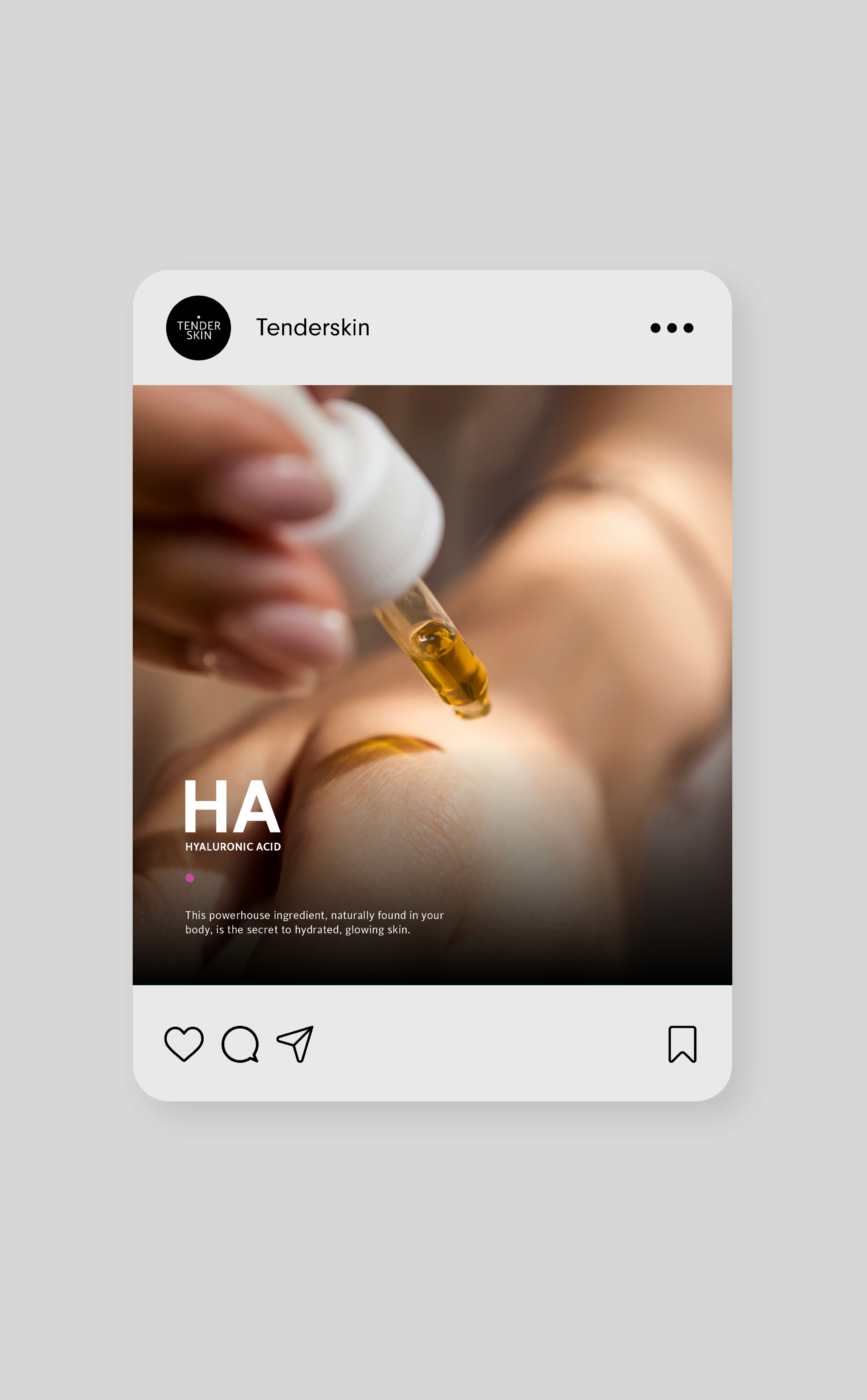
The system holds at one rule: the icon and the typography never change; only colour does. The original three products, C, A, HA, each take their own accent colour against a deep black and near-white ground. The brand reads as one system at every shelf moment, with the accent colour doing the work of distinguishing one active from another.
The photography is hard-lit and direct. No soft gradients, no lifestyle staging, no aspirational hands holding bottles. The product is shown at the angle Amazon's algorithm rewards and at the angle the customer reads on a phone in a moment of decision. The studio art-directed and managed the photography end-to-end.


Applications
The application library runs from the primary bottle out to every surface the brand sells through. Boxes that hold individual bottles for retail. Multipack cartons for gift and travel sets. The Amazon product listings, including the photography that decides whether the customer scrolls past or stops. Social and digital extensions that carry the same C/A/HA logic into the brand's online presence.
Every application sits inside the same system. The icon stays. The typography stays. Only the accent colour changes per product. A customer who knows the C bottle recognises the A bottle and the HA bottle before reading the label. A new SKU enters the system through colour selection alone, without redesign.

Result
What the design achieved was a skincare brand the laboratory could own. Tender Skin reads as clinical not because it gestures at science but because it was built from the language of science: technical typography, hard photography, a single icon that names the product's category, a system that holds across every SKU.
Several products are now in market on Amazon Mexico. The client has added Snail Musin SM, B3 serum, and XP without returning to the studio, each new product slotting into the existing colour logic and shipping under the same identity. A makeup line is now in production with the studio, the system extending into a second category without rebuilding. The brand operates the way the design intended: one system, any number of products, the studio returning when the range crosses into new territory.

